
Initially named SWAN25B, Comet C/2025 R2 (SWAN) was discovered by amateur astronomer Vladimir Bezugly on 11 September 2025, utilising images from the SWAN (Solar Wind Anisotropies) instrument from the Solar and Heliospheric Observatory. In mid-September, cometary activity showing a developing coma and a tail was evident in images shared by many amateur and professional observers.
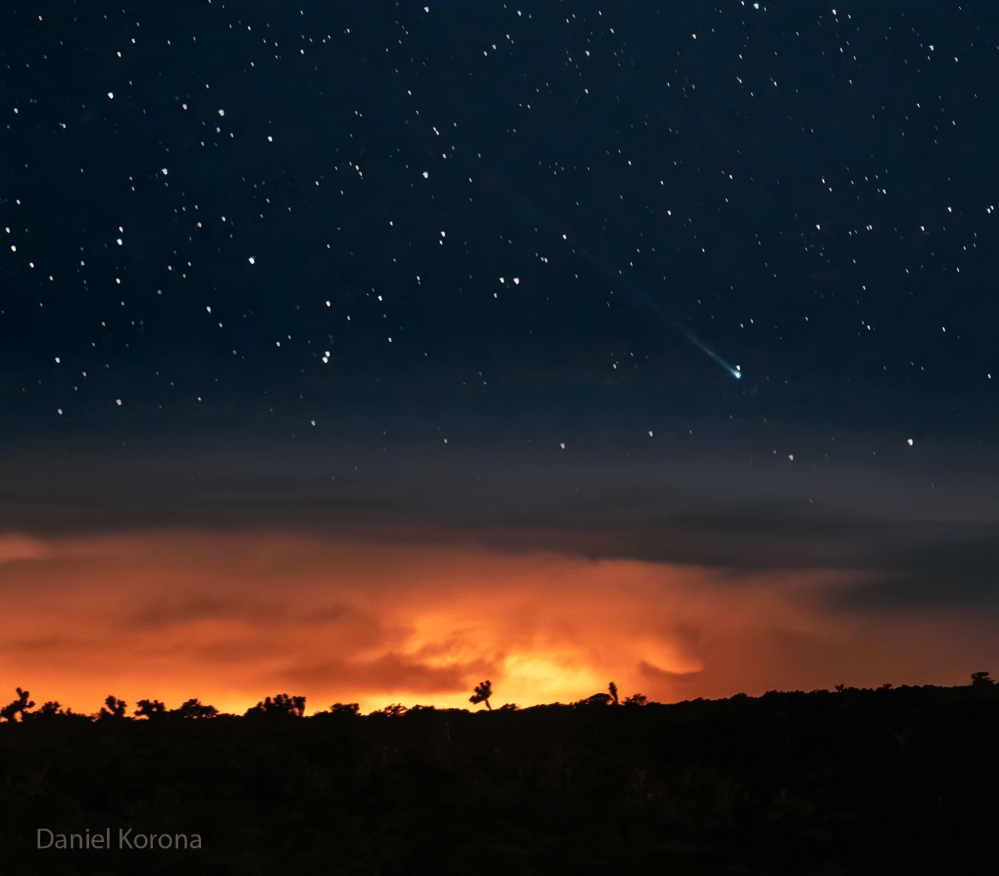
According to words shared by Bezugly with Universe Today, the detection wasn’t in itself challenging because the comet was bright enough in the UV band and was located near the center of the SWAN-generated images. It was the comet’s proximity to the Sun (Holetschek effect) and its nearly similar angular motion that were a bit of a hurdle to overcome.
As of 22 September 2025, 10:49 p.m., the comet is at a distance of about 0.67 Astronomical Units ( ~ 100.7 million kilometres), with an observed magnitude of ~ 6.7, recorded at the Comet Observers Database. It is moving at a speed of about 41 km/s (instantaneous speed), more than 100 times faster than a commercial jet. On 20th October, 2025, it is calculated to be at a distance of 0.26 Astronomical Units (39 million kilometres), marking its closest approach to Earth. Although naked-eye viewing is not possible at the current magnitude, a pair of binoculars or a small telescope would suffice for the purpose. It is definitely a sight not to be missed.
Preliminary calculations suggest an orbital period of about 22,500 years; we are not seeing this cosmic neighbour anytime soon.
Equipment & Observing Tips
Below are some details for a location in Punjab, India.
Note: Altitude and apparent magnitude values are given for 07:02 PM IST, as a practical evening observing reference for Punjab. Comets are highly unpredictable, and the magnitude values in the table may change; it is best to check updated predictions near the observing date (see TheSkyLive comet tracker).
| Date | Predicted mag | Altitude | Apparent mag |
|---|---|---|---|
| 15 Oct | 9.15 | 30° | 9.55 |
| 16 Oct | 9.18 | 32° | 9.56 |
| 17 Oct | 9.22 | 35° | 9.57 |
| 18 Oct | 9.28 | 37° | 9.61 |
| 19 Oct | 9.34 | 40° | 9.65 |
| 20 Oct | 9.42 | 42° | 9.72 |
| 21 Oct | 9.52 | 45° | 9.80 |
| 22 Oct | 9.62 | 47° | 9.89 |
| 23 Oct | 9.74 | 49° | 10.01 |
| 24 Oct | 9.87 | 50° | 10.13 |
| 25 Oct | 10.00 | 52° | 10.25 |
| 26 Oct | 10.14 | 53° | 10.39 |
| 27 Oct | 10.29 | 54° | 10.54 |
| 28 Oct | 10.44 | 55° | 10.68 |
| 29 Oct | 10.59 | 55° | 10.83 |
| 30 Oct | 10.74 | 56° | 10.98 |
| 31 Oct | 10.90 | 56° | 11.14 |
Data collected from TheSkyLive tracker.
Binoculars
- Large binoculars (e.g. 10×50 or 15×70) can show the comet on the brighter dates (before ~22 Oct) if the sky is dark and moonless.
Small Telescopes
- A 4–5″ (100–125 mm) refractor/reflector may show the comet during the brighter phase (mag ~9.5–10).
- A 6–8″ (150–200 mm) Dobsonian or Newtonian is strongly recommended from 25 Oct onwards, as the comet fades toward mag ~11.
- Use a low-power, wide-field eyepiece (20–40×). Comets are diffuse, so too much magnification makes them harder to spot.
As the data shows, the day of closest approach is not the one when the comet will be brightest. It was closest to the Sun (perihelion) on ~12 Sept 2025 at 0.50 AU, also when its activity (gas and dust production) peaked. The day when it will be closest to Earth, already past its perihelion, there will be reduced Sun-driven effects.
Note: Altitude values are for Punjab (Samrala); for other locations in India, the comet will be at similar brightness, with slightly higher altitude in the south.
I wish you clear and dark skies.
Sources: TheSkyLive.com, Universe Today, Comet Observers Database (COBS), Minor Planet Center (MPC).
 Amateur Astronomical Society of Punjab